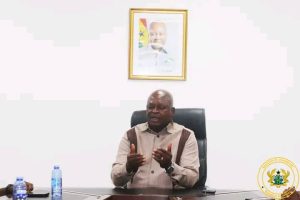
Kwame Akuffo Criticizes Supreme Court’s Ruling on Vacant Seats

Kwame Akuffo Criticizes Supreme Court’s Ruling on Vacant Seats
|
Getting your Trinity Audio player ready...
|
In a scathing critique, prominent private legal practitioner Kwame Boafo Akuffo has voiced strong opposition to the Supreme Court’s handling of the recent parliamentary vacant seats saga. His criticism focuses on what he sees as procedural missteps and a lack of adherence to established legal principles.
Akuffo takes particular issue with the Court’s decision on Alexander Afenyo-Markin’s application for a Stay of Execution, arguing that it lacked both procedural integrity and a sound legal basis.
Inconsistency in Legal Practice
In a detailed commentary, Akuffo highlights the importance of consistent application of legal principles, noting that inconsistency can undermine the coherence of the law. “The importance of consistency in the application of the principles of law is necessary as inconsistency tends to undermine the coherence of the law and generates a mass of disparate special rules distinct from those known under the law,” he remarked.
Akuffo argues that the Court’s decision has introduced legal contradictions that could set a dangerous precedent.
Jurisdictional Overreach and Procedural Flaws
Akuffo’s primary contention centers on the nature of the application itself. He asserts that a Stay of Execution can only be sought in response to a judicial order or judgment, which, in this case, did not exist. The application, he explained, was based solely on the Speaker of Parliament’s declaration of the seats as vacant, which is not a judicial ruling.
“A party cannot seek an Application for Stay of Execution in respect of a matter which is not a Judgment or a Court order. The Speaker’s order is not of such,” Akuffo emphasized. He believes this should have disqualified the court from hearing the case, suggesting it was a clear example of jurisdictional overreach. “It is absurd to seek a Stay of Execution in a case in which the Court has not made any orders.”
Failure to Address a New Cause of Action
Beyond this procedural error, Akuffo also pointed to a deeper legal flaw: the Speaker’s declaration of the seats as vacant created a new cause of action that the applicant did not properly address in their filing. The original case was based on a situation in which the seats were not yet declared vacant, but by the time of the hearing, the facts had changed.
“At the date of hearing, the Application was not in sync with the writ before the Court,” Akuffo noted, stressing that this inconsistency should have been resolved before any ruling was made. Failing to amend the writ to reflect the new situation, he argued, led to a fundamentally flawed legal process. “You cannot put new wine in old wineskins. It cannot hold.”
Unanswered Constitutional Questions
A central element of Akuffo’s critique is his concern over constitutional jurisdiction. He referenced Article 99 of the 1992 Constitution, which governs disputes over parliamentary seats, and questioned whether the case should have been referred to the Supreme Court at all.
“The Court’s assumption of jurisdiction in the face of Article 99… leaves a lot of unanswered questions,” he stated, suggesting that the proper procedure would have involved the High Court referring the matter to the Supreme Court. Akuffo implied that overlooking this critical step could represent a constitutional breach, raising broader questions about the Court’s role in such matters.
In summary, Kwame Akuffo’s analysis of the case paints a picture of judicial overreach, procedural missteps, and unresolved constitutional issues, leaving the Supreme Court’s ruling open to serious legal scrutiny.